 Annika Schmitz

Smart Environment
The course shows how developments in computer and sensor technology have led to smart systems, as found in e.g. ambient intelligence, urban sensing, crowd sourcing and wireless sensor networks. These systems are networks of embedded computers, smart mobile phones and smart sensors. In small groups, we deliver (design and build) an application based on ready-to-use smart technology components such as sensors, wireless sensors nodes, rfid tags and smartphones. During the course we, the students, present their ideas, designs and prototypes.
Our Project - V.i.
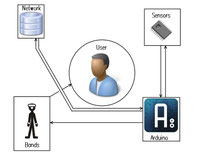
The course Smart Environment consists of a project work and some lectures. As a group we have to design a prototype which is "Smart Environment" we also have to include the Arduino microcontroller with sensors.
It was hard to find the perfect idea. But after some researches we found a side where somebody designed an Arduino glove for blind people. We thought this is a good idea but not perfect so we want to make a better version and to revise the arduino glove.
The idea is the same but we are using a headband (360° overview) and sweat bands, so no glove. We also want to connect the sensors with google maps and with our voice you can enter your destination.
Our final project prototype should be something like this. A device which will help blind people, using something like sonar sensors. This way the device will detect the user of possible obstructions, walls and other things which might be difficult for the blind people to spot. Also, our prototype should be sufficient enough to substitute the white cane. Ergo, the range of our detection system will be greater than the stick. The device will display the information of objects in the vicinity in the form of a sound/vibration. The user will have to plug in headphones or earplugs to hear these sounds. The loudness and whether the sound is played on either the right or the left side will tell the user about the position of objects located in the vicinity. The project device will also warn the user of possible oncoming threats (like a car) in the form of a high beep or warning signal. If we encounter any other uses for our prototype, we will consider implementing it in the final version. We will weigh the pros and cons of the addition in order to make our final judgment whether or not to add it. In short, the prototype will do the following:
- The ability to navigate the user through a maze of objects, without the use of visual senses and by only relying on the device (so no poking around with your hands either).
- The application to warn the user of oncoming threats. The device will always check if there are incoming objects. If they get within a so-called 'danger-zone' (a set distance of say, 100
meter) of the device without slowing down or anything, a warning sound will be played in the ears of the user.
- The ability to plug in headphones to display the sounds for the navigation.