 Annika Schmitz
Opening of a Museum exhibition “Das Erbe der Morrien”


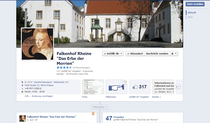
Wilhelm von Morrien auf Facebook
Annika Schmitz begleitet die große Morrien-Ausstellung im Falkenhof-Museum virtuell

-kd- RHEINE. Ernst schaut er auf seinem Ölporträt drein, der Wilhelm von Morrien. Aber vor 450 Jahren ließen sich mächtige Männer eben so malen – würdevoll und Respekt einflößend. Ob es dem Ahnherrn der westfälischen Adelsfamilie, die über 250 Jahre lang auf dem Falkenhof lebte, wohl gefallen hätte, dass sein Konterfei demnächst auf Facebook virtuell herumgereicht, „geteilt“ und bewertet wird? Egal, er wird es nicht verhindern können. „Wenn wir heute junge Menschen ins Museum holen wollen, können wir auf virtuelle Medien und soziale Netzwerke wie Facebook nicht verzichten“, weiß Mechthild Beilmann-Schöner, Leiterin der städtischen Museen. Und weil Facebook ein junges Medium ist, hat sich das Falkenhof-Team auch einer ganz jungen Expertin versichert, der 25-jährigen Annika Schmitz aus Rheine. Die junge Dame studiert seit zwei Jahren „Creative Technology“an der Unversität Twente in Enschede.
The project
1. Setting
The research about the project for the course “Creative Explorations” started this year during April. The idea or project should include a mixture of project management, technology and
creativity. A friend of mine, Kerstin Schrader a technical illustrator, told me about the Falkenhof Museum in Rheine and their
upcoming exhibition. The Falkenhof is one of the famous monuments of the region and is mentioned first in 838. The Dionysius church in the city center and the Falkenhof are the oldest buildings
in Rheine. In 1371, the family von Falke moved into the court. During this time the name “Falkenhof” arose. Because of the marriage between Anna von Falke and Dietrich von Morrien in 1521, a new
family moved into the Falkenhof. Until 1799, the Westphalian gentry family von Morrien was over generations the administrator of the Falkenhof. Today, the Falkenhof is a city museum, venue and a
popular building for the public. Between May and October in 2003, a pit was found during construction work. Archaeologists found out that this pit was used as a refuse pit. They also round about
21.000 fragments of ceramic, glass, metal, leather and wood. After a while, they realized after a while that the findings are from the 19th century but also from the baroque period. Mostly none
of the findings were complete but they prove the prosperity and the upper lifestyle of the genteel aristocratic family. The Archaeologists needed 10 years for cleaning, sorting and assembling the
findings. The best restored objects and the results of research of the finds are presented to the public in an exhibition “Das Erbe der Morrien”. The corpus of finds 10 years ago was amazing for
the city Rheine. The opening of the exhibition was set on the 12th of October 2013 and the duration is planned for one year. In the first meetings at the Falkenhof Museum, the team told me, why
they need my help and what their gaps are. They informed me that they are unexperienced about the new technological possibilities and they are also kind of insecure about social media. Another
gap was that they need a bigger target audience so that also younger people are coming to the exhibition. The target group in the past was uniform and covers only a fragment of the intended
target group. They needed a person who can tell from a view of a 26 years old person, how to make the opening and especially the promotion of the exhibition, more interesting and more attractive
for the audience in this age group. A general problem for most of the historical museums is that the target audience is mostly the same. The main target audiences are school classes, so pupils
and people older than 30 years. The audience between 18 and 30 years are not addressed or not interested in museums. Another reason for this could be that the topics of the exhibition are not
relevant for the questions people have in this age group. The Falkenhof Museum is directed towards the educated middle-class, which is maybe not the point of interest for the youth. Also the
general advertising effort could be unattractive for this audience. Other ways may be necessary to reach the missing target group.
2. Assignment
The first meeting with the Falkenhof Team included an update about the current situation of the exhibition planning and we discussed also the assignment I have to work on the upcoming weeks. What
kind of creative and technological measures can be used to attract the exhibition “Das Erbe der Morrien” for the missing younger target group?
3. Ideation
Especially for getting the missing target audience, I created some ideas of promotion, but there were several points why they could not be realized. To come up with the ideas, an intense
brainstorming was necessary. Asking friends and fellow students which are in the missing target group and the family members for possible promotion actions has been one part. Also searching via
the internet for already realized guerrilla marketing ideas was useful. It was also helpful to talk with an employee and also friend from an event agency, what measures they use for an opening.
They never worked on an opening for a museum’s exhibition but it was useful for the collection of ideas. The timeframe to promote and create the advertisements was just three months, so less time
for “new” ideas or developments. But some ideas will be realized during the exhibition so in the coming year. Also the factor money was one reason why the attention about great technological
ideas was disregarded. Technique costs money and the city mostly has not enough money. Also if the team would like my creative ideas, they need permission from the city council and this means
they have to wait for permission. But not only the money or time was an obstacle, also the fear about the technological possibilities which were new for them.