 Annika Schmitz
Hybrid Worlds


Our Project
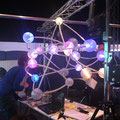
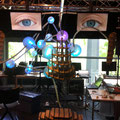
Neural networks in computer science are inspired by certain properties of biological signalling systems that form a cornerstone of life; being utilized to solve artificial intelligence problems and mimic learning behaviour and pattern recognition, they are highly valuable for tackling some of the traditionally most problematic fields in computer intelligence. The goal of this project is to make an artistic, interactive and aesthetically pleasing representation of the mind of a composer. This mind will be influenced by the several senses that the brain employs to determine how it should feel and react. It will be physically represented by nodes that emit light and connections between these nodes that visualize the messages that are being sent between them in a neural network fashion. People will be able to interact with these senses in a way that feels natural and makes sense in the mind of the users. This interaction will change the mood and state of the node it is connected too. This state will distribute to other nodes in a way that is like a neural network. Just a composer will create his compositions based on his mood, this system will do the same. Different parts of the neural network will represent different instruments and will create melodies and rhythms according to the mood of the network. This will result in a dynamic soundtrack that reacts to the users and the environment.


Personal reflection
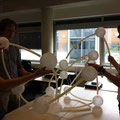
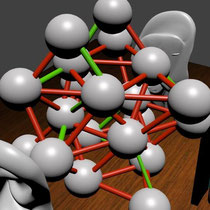
As part of the physical design group I created a prototype/model for us and for the other groups because it was important to know which neuron/ball has which function and exact position. Because we decided to use two different sizes of tubes for the connection, we could always use the model for it. It was nice that we could get the tubes from Emiel (LED group) so that Leonie Hartl and I just had to cut them through the right length. After that I ordered the acrylic plate for the connections between tube and ball and the other group members started to laser cut the wholes into the balls. After we glued the connections on the balls we started to work together with the LED group. So Leonie and I soldered the cables for the LED stripes with connectors so that we could connect the Stripes with each other. Actually the hardest part was to build the actual installation because we had to keep in mind the direction and position of each ball and also the direction and connection between the LED stripes. Because of the model I made at the beginning we could compare the model with the real installation. The only risk we always had was that the balls are stable enough and nothing breaks down. To make the installation more stable we taped the balls because each ball has two halves which is good for the technique but not for the resistance. The whole neuron network will be a hanging installation so we used a fishing line which is transparent and connected them on the balls (each ball had already a fixation). If we are done with the neuron network, we will help the sensor group with the organs.
My role in the physical design group was the group leader. This means that I organized everything we needed like material and also coordinating the meetings and deadlines for us. Personally the physical design was a perfect choice for me because I liked to work in the workshop or other hand work.