 Annika Schmitz
Living and Working Tomorrow
In this creative application, the student explores in a group, the application of several new technologies in a future living or working situation. After investigating new technologies, application scenarios will be generated. Concepts for these scenarios will be developed, resulting in creating and evaluating a prototype. In project-lectures the relevant tools are presented. Also, a basic course in writing a report is given. Upon completion the student is aware of characteristics of new technologies and is able to identify opportunities for exploitation of a technology. In particular the possibilities of cooperating sensors and actuators to create "smart behaviour" of the system will be explored. Also, the student is familiar with working in a group, organising the work, and writing a legible report. The goal of this course is to explore new technologies for a future living and working situation. The students will get hands-on experience with state-off-the-art technology, integrating the knowledge gained from previous courses and courses that run during the project. Students will become familiar with working in a group, organising the work, and writing a structurized report.
Our project - MODULAR FLOOR
Project Statement
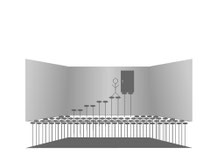
Is it feasible to create more space in a house by implementing a modular floor?
Stakeholders
- Construction companies
- People who life is small houses
- Discotheque owners
State Of The Art
This project is inspired by the floors in swimming pools and soccer stadiums. The floor of some swimming pools can move up and down to create different depths (http://www.admfloors.com/moving-swimming-pool-floors.php). In some soccer stadiums the field can be moved under the ground, leaving something like a concrete floor.
Another inspiration is the ‘Pin Art’ toy. You can put things in the toy, for example your own hand, and it shows the thing you put in it at the other side of the toy in the form of pin sticking out.
Emotional Content
This project makes it possible for people to create the room they want fitting with their needs.
Factual Information
- The size of the modular floor depends on the size of the room.
- The pins are controlled individually or in small groups.
- There is software attached so people can select and/ or design the furniture and chose the place of the furniture on the floor.
- With a remote controller you can select preset options.
- The pins can stick out of the floor in different heights.
Inspiration
This project is inspired by the Karwei marketing campaign (http://www.youtube.com/watch?v=rbHWAt3emmQ&feature=related). In their TV spots you see the room changes to the wishes/ thoughts of the owners.
Strong Points
- The room is better exploited.
- The room can be used for different situations.
Weak Points
- Complex mechanism.
- Uses a lot of space underneath the surface.
- By changing the room, the objects in the room, for example plates or flowers, could end up at spots they are a problem.
- Costs could be high.
Costs
- Development of a scale model – project
- Development of floor – 50k
- Price per floor – 10k
- Maintenance 2k/floor/year
Publicity value
- Implementing the prototype of the floor in a discotheque could be a good way to show the concept to the world.
- Take advances of the Karwei TV spots.
Related Work
There is a wall that uses pins as art (commonly known as Pin Art) that is basically our idea, however this is just used for interactive art, while we want to use it for a floor and make it bigger.